GLP-1 Clinical Trials Summary: STEP, SURMOUNT, SELECT, FLOW
If you’re researching GLP-1 medications, you’ve likely encountered references to clinical trials with names like STEP 1, SURMOUNT-1, SELECT, and FLOW. These aren’t marketing slogans. They’re large research studies that tested what these medications do, for whom, and under what conditions.
This page is a reference guide to the major GLP-1 trials. It’s organized by medication and indication, with plain-language summaries of the population studied, what the trial measured, and what the results showed. Every trial here studied an FDA-approved brand-name product (or, for SYNERGY-NASH, tirzepatide in a phase 2 study). None studied compounded semaglutide or tirzepatide, and the results cannot be assumed to apply to them.
Weight Loss Trials: The Foundation
STEP Trials (Semaglutide)
The STEP trials are the main evidence base for semaglutide 2.4mg weekly, the dose sold as Wegovy, for weight management. All were funded by Novo Nordisk. Here are the key ones.
STEP 1: Weight Loss in Adults Without Diabetes
Published: NEJM 2021 (Wilding et al.)
Who was studied: 1,961 adults with obesity (BMI 30 or higher, or BMI 27 or higher with at least one weight-related condition) who did not have diabetes[1].
What happened: Participants were randomly assigned (2:1) to semaglutide 2.4mg weekly or placebo, plus a lifestyle intervention. The study ran for 68 weeks and was double-blind[1].
Key results:
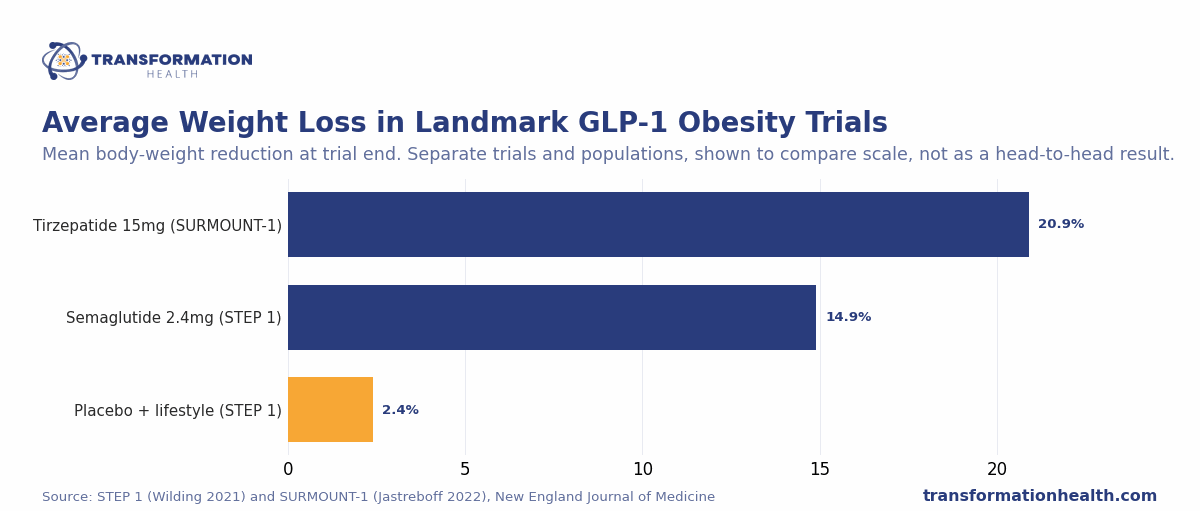
- Average weight change with semaglutide: -14.9%[1] of body weight
- Average weight change with placebo: -2.4% of body weight
- Percentage of participants who lost 5% or more: 86.4%[1] (semaglutide) vs 31.5% (placebo)
- Percentage who lost 10% or more: 69.1%[1] vs 12.0%
- Percentage who lost 15% or more: 50.5%[1] vs 4.9%
Side effects: Nausea and diarrhea were the most common adverse events with semaglutide. They were typically short-lived and mild to moderate, and eased over time. More participants on semaglutide than on placebo stopped treatment because of stomach and bowel side effects (4.5% vs 0.8%)[1].
What it means: STEP 1 showed a large average difference from placebo in adults with obesity or overweight but without diabetes, across every weight loss threshold it measured. Results vary from person to person.
Embed this chart on your site (free)
Copy this code. It credits Transformation Health with a link back to this page.
STEP 2: Weight Loss in Adults With Type 2 Diabetes
Published: Lancet 2021 (Davies et al.)
Who was studied: 1,210 adults with a BMI of 27 or higher AND type 2 diabetes (glycated hemoglobin 7-10%)[2].
What happened: Participants were randomly assigned to semaglutide 2.4mg, semaglutide 1.0mg (the dose approved for diabetes treatment), or placebo once a week for 68 weeks, plus a lifestyle intervention[2].
Key results:
- Average weight change with semaglutide 2.4mg: -9.6%[2]
- Average weight change with placebo: -3.4%
- Lost 5% or more: 68.8% with semaglutide 2.4mg vs 28.5% with placebo
- Stomach and bowel side effects, mostly mild to moderate: 63.5% with 2.4mg, 57.5% with 1.0mg, 34.3% with placebo[2]
What it means: In people with type 2 diabetes, average weight loss on semaglutide 2.4mg was lower than in STEP 1. STEP 1 and STEP 2 were separate trials with different participants, so the gap between them is not a direct comparison.
STEP 4: What Happens When You Stop
Published: JAMA 2021 (Rubino et al.)
Who was studied: 902 adults with obesity or overweight, without diabetes, started a 20-week semaglutide run-in (16 weeks of dose increases, then 4 weeks at 2.4mg). The 803 who reached the 2.4mg dose, with an average weight loss of 10.6% by week 20, were randomized[3].
What happened: Participants were randomly assigned (2:1) to continue semaglutide 2.4mg weekly or switch to placebo for 48 weeks, with lifestyle intervention in both groups. This was designed to answer: What happens to weight after you stop taking the medication?
Key results:
- Participants who continued semaglutide: average weight change of -7.9% from week 20 to week 68[3]
- Participants who switched to placebo: average weight change of +6.9% over the same period[3]
- Stomach and bowel side effects: 49.1% with continued semaglutide vs 26.1% with placebo
What it means: STEP 4 answered a clinical question: does the weight loss last if the medication stops? On average, people who switched to placebo regained weight, while people who continued kept losing. A separate STEP 1 extension that followed 327 people for a year after stopping found they regained about two-thirds of the weight they had lost[4]. Planned stopping vs. longer-term use is a clinical decision to discuss with a licensed provider.
SURMOUNT Trials (Tirzepatide)
Tirzepatide, sold as Zepbound for weight management, activates two hormone receptors (GIP and GLP-1) instead of one[13]. The SURMOUNT trials were funded by Eli Lilly. Most compared tirzepatide with placebo; SURMOUNT-5 compared it with semaglutide.
SURMOUNT-1: Weight Loss at Multiple Doses
Published: NEJM 2022 (Jastreboff et al.)
Who was studied: 2,539 adults with obesity (BMI 30 or higher, or BMI 27 or higher with at least one weight-related complication), without diabetes[5].
What happened: Participants were randomly assigned to tirzepatide 5mg, 10mg, or 15mg weekly, or placebo. The study ran for 72 weeks, including a 20-week dose-escalation period, and was double-blind[5].
Key results:
- Average weight change with 5mg: -15.0%[5]
- Average weight change with 10mg: -19.5%[5]
- Average weight change with 15mg: -20.9%[5]
- Average weight change with placebo: -3.1%
Responder rates at the 15mg dose:
- 91% lost 5% or more[5] (vs 35% on placebo)
- 57% lost 20% or more[5] (vs 3% on placebo)
What it means: SURMOUNT-1 showed a large average difference from placebo at every dose, with higher averages at 10mg and 15mg. The most common side effects were stomach and bowel related, mostly mild to moderate, and occurred mainly during dose increases. Side effects led 4.3%, 7.1%, and 6.2% of the 5mg, 10mg, and 15mg groups to stop, compared with 2.6% on placebo[5]. STEP 1 and SURMOUNT-1 were separate trials, so their results cannot be compared directly; see SURMOUNT-5 below and side effects compared.
SURMOUNT-4: Maintenance of Weight Loss
Published: JAMA 2024 (Aronne et al.)
Who was studied: 783 adults with obesity or overweight, without diabetes, started a 36-week open-label lead-in on the highest tolerated dose of tirzepatide (10mg or 15mg). The 670 who completed it, with an average weight loss of 20.9%, were randomized[6].
What happened: Participants were randomly assigned (1:1) to continue tirzepatide or switch to placebo for 52 weeks, double-blind.
Key results:
- Participants who continued tirzepatide: average weight change of -5.5% from week 36 to week 88[6]
- Participants who switched to placebo: average weight change of +14.0% over the same period[6]
- Overall average change from week 0 to week 88: -25.3% with continued tirzepatide vs -9.9% for those switched to placebo
What it means: Like STEP 4, SURMOUNT-4 found that stopping the medication led to substantial regain on average, while continuing maintained and added to the earlier weight loss.
SURMOUNT-5: Head-to-Head Comparison
Published: NEJM 2025 (Aronne et al.)
Who was studied: 751 adults with obesity but without type 2 diabetes[7].
What happened: Participants were randomly assigned (1:1) to the highest dose they tolerated of tirzepatide (10mg or 15mg) or semaglutide (1.7mg or 2.4mg), once weekly for 72 weeks. The trial was open-label (participants knew which medication they took) and was funded by Eli Lilly, which makes tirzepatide[7].
Key results:
- Average weight change with tirzepatide: -20.2%[7]
- Average weight change with semaglutide: -13.7%[7]
- Average waist change: -18.4 cm with tirzepatide vs -13.0 cm with semaglutide
- Most common side effects in both groups: stomach and bowel related, mostly mild to moderate, mainly during dose increases
What it means: SURMOUNT-5 is the one large head-to-head comparison of the two medications. On average, weight loss was greater with tirzepatide. These are averages; some people do better on semaglutide than some people on tirzepatide. The trial did not test the higher 7.2mg Wegovy dose now on the label[12]. Which medication may fit depends on your health history, side effects, coverage, and cost, and a licensed provider decides what is appropriate.
Cardiovascular & Metabolic Health Trials
SELECT: Semaglutide and Cardiovascular Outcomes
Published: NEJM 2023 (Lincoff et al.)
Who was studied: 17,604 adults aged 45 or older with preexisting cardiovascular disease and a BMI of 27 or higher, without diabetes[8].
What happened: This was an event-driven outcomes trial, funded by Novo Nordisk. Participants were randomly assigned to brand-name semaglutide 2.4mg weekly or placebo. Mean exposure to treatment was 34.2 months and mean follow-up was 39.8 months[8].
Key results:
- Major adverse cardiovascular events (MACE: cardiovascular death, nonfatal heart attack, or nonfatal stroke): 6.5% with semaglutide vs 8.0% with placebo[8]
- Hazard ratio: 0.80 (95% CI 0.72-0.90), about a 20% lower risk over the trial period
- In absolute terms, that is 1.5 fewer events per 100 participants over the trial
- Side effects leading to permanent discontinuation: 16.6% with semaglutide vs 8.2% with placebo[8]
Why this trial matters: Semaglutide had already been shown to reduce cardiovascular events in people with diabetes. SELECT tested whether it did so in people with overweight or obesity and cardiovascular disease but without diabetes[8]. The Wegovy label now includes reducing the risk of major cardiovascular events in adults with established cardiovascular disease and either obesity or overweight[12].
What it means: If you have cardiovascular disease and obesity or overweight, SELECT is part of the evidence a licensed provider may weigh. The results apply to the brand-name medication studied, not to compounded products.
FLOW: Semaglutide and Kidney Health
Published: NEJM 2024 (Perkovic et al.)
Who was studied: 3,533 adults with type 2 diabetes AND chronic kidney disease[9].
What happened: Participants were randomly assigned to semaglutide 1.0mg weekly (the Ozempic dose, not the 2.4mg Wegovy dose) or placebo. Median follow-up was 3.4 years; the trial stopped early after a prespecified interim analysis recommended it[9]. It was funded by Novo Nordisk.
Key results:
- Primary composite outcome (kidney failure, a 50% or greater drop in kidney function, or death from kidney-related or cardiovascular causes): 24% lower risk with semaglutide[9]
- Hazard ratio: 0.76 (95% CI 0.66-0.88)
- Kidney function declined more slowly with semaglutide, and serious adverse events were reported in 49.6% of the semaglutide group vs 53.8% of the placebo group[9]
Why this trial matters: The Ozempic label now includes reducing the risk of sustained kidney function decline, end-stage kidney disease, and cardiovascular death in adults with type 2 diabetes and chronic kidney disease[14].
What it means: If you have type 2 diabetes and chronic kidney disease, FLOW is part of the evidence a licensed provider may weigh. It did not study people without diabetes.
Specialty Indication Trials
SURMOUNT-OSA: Tirzepatide and Sleep Apnea
Published: NEJM 2024 (Malhotra et al.)
Who was studied: Adults with obesity and moderate to severe obstructive sleep apnea (OSA), in two trials: one for people not using positive airway pressure (PAP) and one for people already using it[10].
What happened: Participants were randomly assigned to the highest tolerated dose of tirzepatide (10mg or 15mg) or placebo for 52 weeks. The main measure was the apnea-hypopnea index (AHI), how many times per hour breathing stops or becomes shallow during sleep. Average AHI at the start was about 50 events per hour[10].
Key results:
- Without PAP: AHI fell by 25.3 events per hour with tirzepatide vs 5.3 with placebo[10]
- With PAP: AHI fell by 29.3 events per hour with tirzepatide vs 5.5 with placebo[10]
- The most common side effects were stomach and bowel related, mostly mild to moderate
Why this trial matters: The Zepbound label now includes treating moderate to severe obstructive sleep apnea in adults with obesity[13].
What it means: If you have sleep apnea and obesity, SURMOUNT-OSA is part of the evidence a licensed provider may weigh alongside other sleep apnea treatments.
ESSENCE: Semaglutide for Fatty Liver Disease
Published: NEJM 2025 (Sanyal et al.)
Who was studied: 1,197 adults with biopsy-confirmed MASH (metabolic dysfunction-associated steatohepatitis, an inflammatory form of fatty liver disease) and moderate or advanced liver fibrosis (stage F2 or F3). Results so far come from a planned interim analysis of the first 800 participants at week 72[11].
What happened: Participants were randomly assigned (2:1) to semaglutide 2.4mg weekly or placebo, in a trial planned to run 240 weeks and funded by Novo Nordisk[11].
Key results:
- Resolution of steatohepatitis without worsening of fibrosis: 62.9% with semaglutide vs 34.3% with placebo[11]
- Estimated difference: 28.7 percentage points
- Reduction in fibrosis without worsening of steatohepatitis: 36.8% vs 22.4%
- Stomach and bowel side effects were more common with semaglutide
Why this trial matters: The Wegovy label now includes treating noncirrhotic MASH with moderate to advanced liver fibrosis (F2 to F3) in adults. That indication is under accelerated approval, and continued approval may depend on a confirmatory trial showing clinical benefit[12].
What it means: If you have been told you have MASH with fibrosis, ESSENCE is part of the evidence a licensed provider may weigh.
SYNERGY-NASH: Tirzepatide for Fatty Liver Disease
Published: NEJM 2024 (Loomba et al.)
Who was studied: 190 adults with biopsy-confirmed MASH and moderate or severe fibrosis (stage F2 or F3)[15].
What happened: This was a phase 2, dose-finding trial. Participants were randomly assigned to tirzepatide 5mg, 10mg, or 15mg weekly, or placebo, for 52 weeks. It was funded by Eli Lilly[15].
Key results:
- Resolution of MASH without worsening of fibrosis: 44%, 56%, and 62% with 5mg, 10mg, and 15mg vs 10% with placebo[15]
- The most common side effects were stomach and bowel related, mostly mild or moderate
Why this trial matters: SYNERGY-NASH was a smaller, phase 2 trial. Its authors said larger and longer trials are needed[15]. MASH is not an indication on the current Zepbound label[13].
What it means: As of the current labels, semaglutide (Wegovy) has an FDA-approved MASH indication and tirzepatide does not.
Quick-Reference Trial Summary Table
| Trial Name | Drug | Population | N | Duration | Key Result |
|---|---|---|---|---|---|
| STEP 1 | Semaglutide 2.4mg | Obesity, no diabetes | 1,961 | 68 weeks | -14.9% vs -2.4% placebo |
| STEP 2 | Semaglutide 2.4mg or 1.0mg | Overweight or obesity + T2D | 1,210 | 68 weeks | -9.6% (2.4mg) vs -3.4% placebo |
| STEP 4 | Semaglutide 2.4mg | Completed 20-week run-in | 803 randomized | 20-week run-in + 48 weeks | -7.9% continued vs +6.9% switched to placebo |
| SURMOUNT-1 | Tirzepatide (5-15mg) | Obesity, no diabetes | 2,539 | 72 weeks | -15.0% to -20.9% by dose vs -3.1% placebo |
| SURMOUNT-4 | Tirzepatide (10 or 15mg) | Completed 36-week lead-in | 670 randomized | 36-week lead-in + 52 weeks | -5.5% continued vs +14.0% switched to placebo |
| SURMOUNT-5 | Tirzepatide vs semaglutide | Obesity, no T2D | 751 | 72 weeks | -20.2% vs -13.7% (open-label, Lilly-funded) |
| SELECT | Semaglutide 2.4mg | CVD, no diabetes, BMI 27+ | 17,604 | 39.8 months mean follow-up | MACE 6.5% vs 8.0% placebo (HR 0.80) |
| FLOW | Semaglutide 1.0mg | T2D + CKD | 3,533 | 3.4 years median | 24% lower risk of major kidney disease events (HR 0.76) |
| SURMOUNT-OSA | Tirzepatide (10 or 15mg) | Obesity + moderate to severe OSA | Two trials | 52 weeks | AHI -25.3 vs -5.3 (no PAP); -29.3 vs -5.5 (PAP) events/hour |
| ESSENCE | Semaglutide 2.4mg | MASH with F2-F3 fibrosis | 800 (interim of 1,197) | 72 weeks (interim) | 62.9% vs 34.3% steatohepatitis resolution |
| SYNERGY-NASH | Tirzepatide (5-15mg), phase 2 | MASH with F2-F3 fibrosis | 190 | 52 weeks | 62% (15mg) vs 10% placebo MASH resolution |
What These Trials Tell You About Your Situation
The trial data answers several practical questions you might be asking:
“How much weight will I lose?” No trial can tell you that. In STEP 1, the average was -14.9% at 68 weeks; in SURMOUNT-1, -15.0% to -20.9% depending on dose at 72 weeks[1][5]. Individual results ranged widely around those averages and depend on your starting weight, the dose reached, eating and activity habits, and other health factors. For how that loss unfolded over time in the trials, see the GLP-1 weight loss timeline. Keep in mind that these figures come from trials of the FDA-approved products; compounded versions have not been evaluated by the FDA, and the evidence behind compounded semaglutide and compounded tirzepatide is covered separately.
“What if I stop taking it?” STEP 4 and SURMOUNT-4 show that weight regain happens on average when people switch to placebo[3][6]. This doesn’t mean the medication “failed.” It means the medication works by acting on appetite and hunger signals, and those signals return when it stops. Whether you continue longer term, use it to reach a goal and then stop, or take breaks depends on your health goals and your prescriber’s advice.
“Are there benefits beyond weight loss?” These trials looked at more than weight. SELECT studied cardiovascular events, FLOW studied kidney outcomes in type 2 diabetes, SURMOUNT-OSA studied sleep apnea, and ESSENCE and SYNERGY-NASH studied fatty liver disease. Each applies to the specific population and product studied, and only some have led to label indications (cardiovascular risk and MASH for Wegovy, kidney outcomes for Ozempic, sleep apnea for Zepbound)[12][13][14].
“Which medication should I use?” In SURMOUNT-5, average weight loss was greater with tirzepatide than with semaglutide[7]. Semaglutide has label indications that tirzepatide does not (cardiovascular risk reduction and MASH), and tirzepatide has a sleep apnea indication. Cost, side effects, coverage, and your health history all matter, and a licensed provider decides what is appropriate. If you want a starting point before that conversation, which GLP-1 program fits your situation walks through the tradeoffs.
Transformation Health does not accept payment from providers. How we make money.
Side Effects and Safety
The trials above report benefits. Here is what the current FDA labels say about risk.
Common side effects. The most common side effects of Wegovy include nausea, diarrhea, vomiting, constipation, abdominal pain, abnormal skin sensations (dysesthesia), headache, fatigue, indigestion, dizziness, bloating, burping, low blood sugar in people with type 2 diabetes, gas, stomach flu, reflux, and hair loss[12]. The most common side effects of Ozempic are nausea, vomiting, diarrhea, abdominal pain, and constipation[14]. The most common side effects of Zepbound include nausea, diarrhea, vomiting, constipation, abdominal pain, indigestion, injection site reactions, fatigue, allergic reactions, burping, hair loss, and reflux[13].
Boxed warning and who should not use them. All three labels carry a boxed warning about thyroid C-cell tumors seen in rodents. It is unknown whether these medications cause such tumors, including medullary thyroid carcinoma, in humans. They should not be used by people with a personal or family history of medullary thyroid carcinoma or with Multiple Endocrine Neoplasia syndrome type 2, or by people with a known serious allergy to the medication[12][13][14].
Other warnings. The labels also warn about acute pancreatitis, gallbladder disease, low blood sugar when used with insulin or sulfonylureas, kidney injury from dehydration, serious allergic reactions, and diabetic retinopathy complications in people with type 2 diabetes, among other risks[12][13][14]. Read the full labels linked in the citations, and ask a licensed provider how these risks apply to you.
Accessing Clinical Trial Data
All major trials referenced here are published in peer-reviewed journals (NEJM, Lancet, JAMA) and their abstracts are free on PubMed. The citations below link to each one. The abstract and results sections are usually the most useful parts.
A licensed provider can discuss how these trial results apply to your health history, other conditions, and goals. Trial populations are large, but they don’t include everyone, and a trial average is not a personal prediction.
We're relaunching soon
We're relaunching as an independent GLP-1 guide. Leave your email and we'll let you know when your free custom report is ready.
Get StartedThis content is for general education and is not medical advice. Talk with a licensed provider about your situation.
Results vary. Trial results describe study participants and are not a prediction for any individual. The trials on this page studied FDA-approved brand-name semaglutide (Wegovy, Ozempic) and tirzepatide (Zepbound), except SYNERGY-NASH, a phase 2 trial of tirzepatide.
Compounded medications are not FDA-approved. The FDA does not review them for safety, effectiveness, or quality. Compounded semaglutide and tirzepatide are not the same as brand-name products such as Wegovy, Ozempic, or Zepbound. They may differ in formulation, purity, and potency.
Wegovy and Ozempic are trademarks of Novo Nordisk A/S. Zepbound is a trademark of Eli Lilly and Company. Transformation Health is not affiliated with or endorsed by these companies.
Citations
[1] Wilding JPH, Batterham RL, Calanna S, et al. “Once-Weekly Semaglutide in Adults with Overweight or Obesity.” N Engl J Med. 2021;384(11):989-1002. https://pubmed.ncbi.nlm.nih.gov/33567185/ (STEP 1: 1,961 adults; -14.9% vs -2.4% at 68 weeks; responder rates; GI discontinuation 4.5% vs 0.8%; funded by Novo Nordisk.)
[2] Davies M, Faerch L, Jeppesen OK, et al. “Semaglutide 2.4 mg once a week in adults with overweight or obesity, and type 2 diabetes (STEP 2): a randomised, double-blind, double-dummy, placebo-controlled, phase 3 trial.” Lancet. 2021;397(10278):971-984. https://pubmed.ncbi.nlm.nih.gov/33667417/ (1,210 adults; 68 weeks; -9.6% with 2.4mg vs -3.4% placebo.)
[3] Rubino D, Abrahamsson N, Davies M, et al. “Effect of Continued Weekly Subcutaneous Semaglutide vs Placebo on Weight Loss Maintenance in Adults With Overweight or Obesity: The STEP 4 Randomized Clinical Trial.” JAMA. 2021;325(14):1414-1425. https://pubmed.ncbi.nlm.nih.gov/33755728/ (902 in run-in, 803 randomized; 10.6% during run-in; -7.9% continued vs +6.9% placebo from week 20 to 68.)
[4] Wilding JPH, Batterham RL, Davies M, et al. “Weight regain and cardiometabolic effects after withdrawal of semaglutide: The STEP 1 trial extension.” Diabetes Obes Metab. 2022;24(8):1553-1564. https://pubmed.ncbi.nlm.nih.gov/35441470/ (327 participants; two-thirds of prior weight loss regained one year after stopping.)
[5] Jastreboff AM, Aronne LJ, Ahmad NN, et al. “Tirzepatide Once Weekly for the Treatment of Obesity.” N Engl J Med. 2022;387(3):205-216. https://pubmed.ncbi.nlm.nih.gov/35658024/ (SURMOUNT-1: 2,539 adults; -15.0%, -19.5%, -20.9% vs -3.1% at 72 weeks; responder rates; discontinuation rates; supported by Eli Lilly.)
[6] Aronne LJ, Sattar N, Horn DB, et al. “Continued Treatment With Tirzepatide for Maintenance of Weight Reduction in Adults With Obesity: The SURMOUNT-4 Randomized Clinical Trial.” JAMA. 2024;331(1):38-48. https://pubmed.ncbi.nlm.nih.gov/38078870/ (783 in lead-in, 670 randomized; 20.9% during lead-in; -5.5% continued vs +14.0% placebo from week 36 to 88; 25.3% vs 9.9% overall.)
[7] Aronne LJ, Horn DB, le Roux CW, et al. “Tirzepatide as Compared with Semaglutide for the Treatment of Obesity.” N Engl J Med. 2025;393(1):26-36. https://pubmed.ncbi.nlm.nih.gov/40353578/ (SURMOUNT-5: 751 adults, open-label, 72 weeks; -20.2% vs -13.7%; waist -18.4 vs -13.0 cm; funded by Eli Lilly.)
[8] Lincoff AM, Brown-Frandsen K, Colhoun HM, et al. “Semaglutide and Cardiovascular Outcomes in Obesity without Diabetes.” N Engl J Med. 2023;389(24):2221-2232. https://pubmed.ncbi.nlm.nih.gov/37952131/ (SELECT: 17,604 adults; 6.5% vs 8.0%, HR 0.80; mean follow-up 39.8 months; discontinuation for adverse events 16.6% vs 8.2%.)
[9] Perkovic V, Tuttle KR, Rossing P, et al. “Effects of Semaglutide on Chronic Kidney Disease in Patients with Type 2 Diabetes.” N Engl J Med. 2024;391(2):109-121. https://pubmed.ncbi.nlm.nih.gov/38785209/ (FLOW: 3,533 adults; semaglutide 1.0mg; HR 0.76; median follow-up 3.4 years.)
[10] Malhotra A, Grunstein RR, Fietze I, et al. “Tirzepatide for the Treatment of Obstructive Sleep Apnea and Obesity.” N Engl J Med. 2024;391(13):1193-1205. https://pubmed.ncbi.nlm.nih.gov/38912654/ (SURMOUNT-OSA: two 52-week trials; AHI -25.3 vs -5.3 and -29.3 vs -5.5 events per hour.)
[11] Sanyal AJ, Newsome PN, Kliers I, et al. “Phase 3 Trial of Semaglutide in Metabolic Dysfunction-Associated Steatohepatitis.” N Engl J Med. 2025;392(21):2089-2099. https://pubmed.ncbi.nlm.nih.gov/40305708/ (ESSENCE part 1: interim analysis of 800 of 1,197 participants at week 72; 62.9% vs 34.3%.)
[12] U.S. Food and Drug Administration. WEGOVY (semaglutide) injection and tablets, prescribing information. Revised 06/2026. https://www.accessdata.fda.gov/drugsatfda_docs/label/2026/215256s025lbl.pdf
[13] U.S. Food and Drug Administration. ZEPBOUND (tirzepatide) injection, prescribing information. Revised 08/2026. https://www.accessdata.fda.gov/drugsatfda_docs/label/2026/217806Orig1s041correctedlbl.pdf
[14] U.S. Food and Drug Administration. OZEMPIC (semaglutide) injection, prescribing information. Revised 05/2026. https://www.accessdata.fda.gov/drugsatfda_docs/label/2026/209637Orig1s039lbl.pdf
[15] Loomba R, Hartman ML, Lawitz EJ, et al. “Tirzepatide for Metabolic Dysfunction-Associated Steatohepatitis with Liver Fibrosis.” N Engl J Med. 2024;391(4):299-310. https://pubmed.ncbi.nlm.nih.gov/38856224/ (SYNERGY-NASH: phase 2; 190 participants; 52 weeks; 44%, 56%, 62% vs 10%.)