How Much Weight Do You Lose on Semaglutide? STEP 1 Data
You want to know if semaglutide will work for you. The honest answer: in clinical trials, most people on semaglutide lost a meaningful amount of weight, but how much any one person loses depends on many factors, not just the medication.
The STEP 1 clinical trial is the landmark study of semaglutide at the 2.4 mg dose used for weight management. It enrolled 1,961 adults with obesity, or overweight plus at least one weight-related condition, who did not have diabetes. Participants took once-weekly semaglutide injections or placebo, plus lifestyle intervention, for 68 weeks[1]. The trial studied the manufacturer’s brand-name product, not compounded versions.
But the headline number, 14.9% average weight loss, tells you what happened on average, not what will happen to you. Here is what the full data distribution looks like, what affects individual results, and how your timeline might differ from the published trial.
STEP 1 trial: the full picture
The STEP 1 trial results are not just a single number. The trial measured how many participants crossed several weight-loss thresholds, because an average hides how widely results are spread.
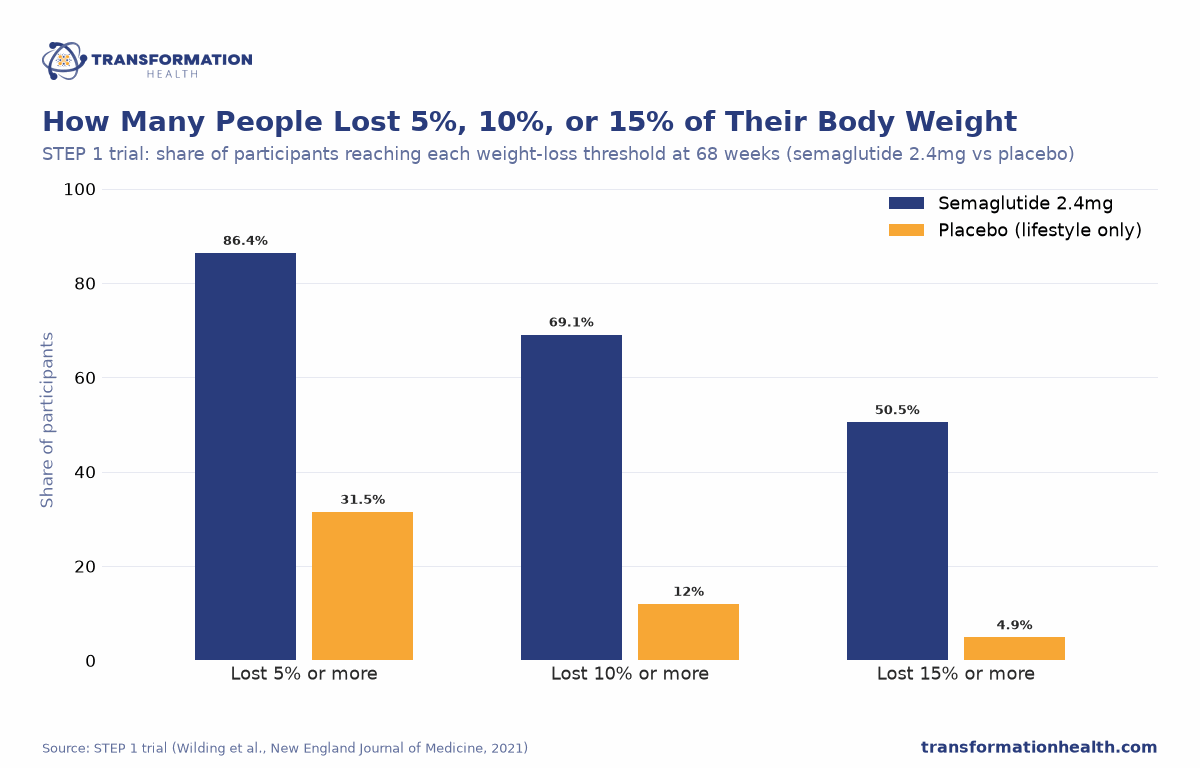
Here is what participants on semaglutide achieved at 68 weeks[1]:
- 86.4% lost at least 5% of their body weight (31.5% on placebo)
- 69.1% lost at least 10% (12.0% on placebo)
- 50.5% lost at least 15% (4.9% on placebo)
- Mean weight change: -14.9%, or about 15.3 kg (roughly 34 pounds), compared with -2.4% (2.6 kg) on placebo
That distribution matters. Losing 5% put a participant in a group that included nearly 9 in 10 people on semaglutide. Losing 15% put them in a group of about 1 in 2. Both are real outcomes documented in the trial, and they describe study participants, not a prediction for you.
Embed this chart on your site (free)
Copy this code. It credits Transformation Health with a link back to this page.
The placebo group received the same lifestyle intervention but no medication and lost 2.4% of body weight on average. The difference, 12.4 percentage points, is the estimated effect of semaglutide in that trial[1].
STEP 2 and STEP 3: different populations, different results
The STEP program included several trials. STEP 2 studied semaglutide 2.4 mg in 1,210 adults with overweight or obesity and type 2 diabetes. Average weight change at 68 weeks was -9.6% on semaglutide 2.4 mg versus -3.4% on placebo[2]. That is lower than in STEP 1, which excluded people with diabetes. The two were separate trials, and the reasons for the difference are not fully established.
STEP 3 enrolled 611 adults without diabetes and paired semaglutide 2.4 mg or placebo with intensive behavioral therapy (30 counseling visits) and a low-calorie diet for the first 8 weeks. Average weight change at 68 weeks was -16.0% on semaglutide versus -5.7% on placebo[3]. The placebo group also lost more than in STEP 1, so the gap attributed to the medication (10.3 percentage points) was similar. STEP 1 and STEP 3 were separate trials with different participants, so their numbers cannot be compared directly.
The takeaway: results depend partly on your health starting point, such as whether you have type 2 diabetes, and partly on what happens alongside the medication.
Higher-dose and oral semaglutide trials
Two newer trials studied other forms of semaglutide, again using the manufacturer’s products.
- Higher dose (STEP UP). 1,407 adults with obesity and without diabetes took once-weekly semaglutide 7.2 mg, 2.4 mg, or placebo for 72 weeks. Average weight change was -18.7% on 7.2 mg, -15.6% on 2.4 mg, and -3.9% on placebo. Gastrointestinal side effects were more common on 7.2 mg (70.8%) than on 2.4 mg (61.2%) or placebo (42.8%), as was dysesthesia, an abnormal skin sensation (22.9% on 7.2 mg)[9]. The current Wegovy label allows up to 7.2 mg weekly for adults who have tolerated 2.4 mg for at least 4 weeks and need more weight reduction; 2.4 mg remains the recommended maintenance dose[11].
- Oral (OASIS 4). 307 adults without diabetes took oral semaglutide 25 mg once daily or placebo. Average weight change at 64 weeks was -13.6% versus -2.2%. Gastrointestinal side effects occurred in 74.0% versus 42.2%[10]. The 25 mg tablet is the maintenance dose of Wegovy tablets[11].
These trials had different durations and participants than STEP 1, so treat each as its own result. Results vary.
Individual variation: why results range so widely
The clinical trial average of 14.9% hides how much results differed from person to person. Participants in the same trial, on the same medication, with the same lifestyle program, ended up in very different places. Several factors can affect how much weight you lose on semaglutide:
Starting weight. The same percentage means more pounds at a higher starting weight. A 10% loss is 30 pounds for someone who starts at 300 pounds and 20 pounds for someone who starts at 200 pounds. Trial results are reported as percentages for this reason.
Dose escalation and adherence. The Wegovy injection label starts at 0.25 mg once weekly and increases every 4 weeks (0.5 mg, 1 mg, 1.7 mg) until the maintenance dose at week 17. If a dose is not tolerated, the label says escalation can be delayed by 4 weeks, and if 2 or more doses in a row are missed, escalation restarts at a lower dose[11]. Spending longer at lower doses can slow progress.
Diet quality during treatment. The medication reduces appetite, but you still make food choices. The Wegovy label pairs the medication with a reduced-calorie diet[11]. Eating enough protein and limiting heavily processed foods are common recommendations while on a GLP-1.
Activity level and resistance training. The label also pairs the medication with increased physical activity[11]. Strength training is often recommended to help preserve muscle while losing weight.
Sleep and stress. Poor sleep and chronic stress can affect appetite and eating patterns. They are worth discussing with a licensed provider, because they are often modifiable. This is biology, not a character flaw.
Type 2 diabetes and other health conditions. In STEP 2, adults with type 2 diabetes lost less on average than participants without diabetes in STEP 1[1][2]. That reflects a different starting point, not how “well” someone is trying.
Age and hormonal status. Many women in perimenopause and menopause describe changes in appetite, weight distribution, and energy. These changes can affect the pace of weight loss; they do not mean the medication cannot work.
Individual biology. Two people with similar habits can respond differently to the same medication, and there is no reliable way to predict response in advance. A licensed provider can help you set expectations based on your health history.
Semaglutide vs tirzepatide: head-to-head data
Tirzepatide is a GIP and GLP-1 receptor agonist, so it acts on one more receptor than semaglutide. In the SURMOUNT-1 trial of 2,539 adults without diabetes, average weight change at 72 weeks was -15.0% on tirzepatide 5 mg, -19.5% on 10 mg, and -20.9% on 15 mg, compared with -3.1% on placebo[4]. STEP 1 and SURMOUNT-1 were separate trials with different participants and durations (68 vs 72 weeks), so setting 14.9% next to 20.9% is a cross-trial comparison that can mislead.
The SURMOUNT-5 trial compared the two directly. It randomly assigned 751 adults with obesity but without type 2 diabetes to the highest dose they tolerated of tirzepatide (10 mg or 15 mg) or semaglutide (1.7 mg or 2.4 mg), injected once weekly for 72 weeks. Average weight loss was 20.2% with tirzepatide and 13.7% with semaglutide[5]. The trial was open-label (participants knew which medication they were taking), was funded by Eli Lilly, which makes tirzepatide, and did not test the 7.2 mg semaglutide dose.
“On average” still masks variation. Some people respond better to semaglutide, and some respond better to tirzepatide. A licensed provider can review your health history and help you choose, and may discuss switching if your response or side effects call for it. Individual response is not fully predictable from trial data. See semaglutide vs tirzepatide for the full comparison.
What semaglutide does and does not do
Semaglutide is a GLP-1 receptor agonist. According to the Wegovy label[11]:
- GLP-1 is a natural regulator of appetite and calorie intake, and semaglutide activates the same receptor
- GLP-1 receptors are present in areas of the brain involved in appetite regulation
- Semaglutide decreases calorie intake, and the effect is likely mediated by appetite
- Semaglutide delays gastric emptying, which can also affect how other oral medicines are absorbed
Many people describe this as quieter “food noise” and feeling full sooner.
What it does not do: semaglutide does not force weight loss. The medication makes eating less easier by reducing hunger, and the label pairs it with a reduced-calorie diet and increased physical activity.
Timeline expectations for weight loss
Weight loss on semaglutide is not linear. The pattern below follows the Wegovy injection dose schedule[11]; individual timelines vary.
Weeks 1-4: The starting dose is 0.25 mg, which is meant to help your body adjust rather than to be the maintenance dose. Many people feel only mild appetite changes.
Weeks 5-16: The dose increases every 4 weeks (0.5 mg, 1 mg, then 1.7 mg). Many people start noticing reduced cravings and earlier fullness. Weight loss is often gradual.
Months 4-6: The maintenance dose (2.4 mg recommended, or 1.7 mg) starts at week 17. Appetite effects are usually more noticeable, and many people see steady weight loss in this window.
Months 6-12: Weight loss often continues at a slower pace. Plateaus are common and normal.
After 12 months: Many people reach a plateau and start talking with their provider about maintenance. This is not medication failure; the body adapts to a lower weight.
Side effects and safety
Benefits are only half the picture. The Wegovy label[11] lists:
- Boxed warning: in rodents, semaglutide causes thyroid C-cell tumors. It is unknown whether it causes these tumors, including medullary thyroid carcinoma (MTC), in humans.
- Who should not use it: people with a personal or family history of MTC or with Multiple Endocrine Neoplasia syndrome type 2 (MEN 2), and people with a known serious allergy to semaglutide or the product’s ingredients.
- Most common side effects: nausea, diarrhea, vomiting, constipation, abdominal pain, dysesthesia, headache, fatigue, indigestion, dizziness, bloating, burping, low blood sugar in people with type 2 diabetes, gas, stomach flu, reflux, and hair loss.
- Warnings: acute pancreatitis, gallbladder disease, low blood sugar when used with insulin or sulfonylureas, kidney injury from dehydration, severe gastrointestinal reactions, serious allergic reactions, diabetic retinopathy complications in people with type 2 diabetes, heart rate increase, and the risk of inhaling stomach contents during anesthesia or deep sedation.
- Pregnancy: when used for weight reduction, stop when pregnancy is recognized, and stop at least 2 months before a planned pregnancy.
In STEP 1, nausea and diarrhea were the most common side effects and were usually temporary and mild to moderate; 4.5% of participants on semaglutide stopped treatment because of gastrointestinal events, compared with 0.8% on placebo[1]. Following the dose escalation schedule is meant to reduce gastrointestinal side effects[11].
What happens to weight after stopping semaglutide
Two STEP studies looked at what happens when semaglutide stops.
- STEP 1 extension. After the 68-week trial, treatment and the lifestyle program ended, and 327 participants were followed for another year. Those on semaglutide had lost 17.3% on average by week 68 and regained 11.6 percentage points by week 120, about two-thirds of the weight they had lost. Most cardiometabolic improvements also moved back toward baseline[7].
- STEP 4. 803 adults who reached the 2.4 mg dose during a 20-week run-in (average loss 10.6%) were randomly assigned to keep taking semaglutide or switch to placebo for 48 weeks. Average weight change over those 48 weeks was -7.9% with continued semaglutide versus +6.9% after switching to placebo[6].
These are averages, and individual results varied. A similar pattern has been seen with tirzepatide: in SURMOUNT-4, adults switched to placebo after 36 weeks regained an average of 14.0% of body weight over the next 52 weeks, while those who continued lost a further 5.5%[8].
This does not mean the medication failed. The STEP 1 extension authors concluded that the findings confirm obesity is a chronic condition and suggest ongoing treatment is needed to maintain the improvements[7]. Some people keep taking the medication at a maintenance dose; others work with their provider on a plan for stopping or lowering the dose. Plan any change with your prescriber.
Compounded vs. branded semaglutide: an important note
Compounded medications are not FDA-approved. The FDA does not review them for safety, effectiveness, or quality. Compounded semaglutide is not the same as brand-name products such as Wegovy and may differ in formulation, purity, and potency.
All the clinical data in this article comes from trials of the manufacturer’s FDA-approved semaglutide. None of these trials studied compounded semaglutide, so their results cannot be assumed to apply to compounded products[13].
FDA determined that the semaglutide injection shortage was resolved on February 21, 2025, and the periods during which FDA did not intend to act against compounders over shortage-dependent conditions have ended (FDA page current as of 04/01/2026)[12]. If a program offers compounded semaglutide, ask which pharmacy prepares it and what form of semaglutide it contains.
Setting realistic expectations for your situation
STEP 1 shows that semaglutide 2.4 mg produced meaningful weight loss in most participants. Whether you would land among the 69% who lost at least 10% or the 50% who lost at least 15% depends on factors within and outside your control.
A licensed provider can help you estimate what a realistic outcome looks like based on:
- Your current weight and BMI
- Your metabolic health markers (blood sugar, blood pressure, cholesterol)
- Whether you have type 2 diabetes or other conditions
- Your diet and activity baseline
- How well you tolerate dose increases
- The habits you can realistically keep up
That conversation is more useful than the trial average because it is specific to you.
What a proper weight loss program should include
If you are comparing programs that prescribe semaglutide, look at more than the medication. A program worth considering should offer:
- A licensed provider who reviews your health history and decides whether a prescription is appropriate
- A dose schedule that follows the label, with a plan for slowing down if side effects are hard to tolerate
- Follow-up visits to check your response and side effects, and a clear way to reach someone between visits
- Lab work when your provider decides it is needed
- Guidance on nutrition, protein, activity, and sleep, or a referral for it
- Clear information on whether the medication is brand-name or compounded, and which pharmacy fills it
- The total cost in writing: medication at each dose, dose increases, provider visits, labs, shipping, membership fees, and cancellation terms
Some programs include coaching or nutrition support; others do not, so check before you sign up. Prices vary by program and dose. STEP 1, STEP 3, and STEP 4 all paired the medication with a lifestyle program[1][3][6], so ask how a program supports those habits.
Transformation Health does not accept payment from providers. How we make money.
The reality: results vary
The STEP 1 data is clear that semaglutide 2.4 mg produced weight loss in most participants. The amount varied widely. Some participants lost more than 15%; others lost 5% or less.
Your results will depend on your starting point, whether you reach and stay on the maintenance dose, food and activity habits, sleep and stress, and factors like age and individual biology that you cannot control. Realistic expectations help you stay with treatment through the early weeks when results feel slow. They help you see a plateau as normal, not failure. And they help you make decisions about dose changes, maintenance, and long-term strategy with your provider based on your actual progress, not hype.
Weeks 1-4: Adjustment phase
Starting dose (0.25 mg) is meant for adjustment, not maintenance. Appetite effects are often mild and weight change may be small. Side effects like mild nausea may occur as your body adapts. This phase is about tolerance.
Weeks 5-16: Appetite effect builds
As doses increase every 4 weeks, many people notice quieter food noise and smaller portions feeling satisfying. Weight loss is often gradual during this window.
Months 4-6: Maintenance dose
The maintenance dose starts at week 17. Appetite effects are usually more noticeable, and many people see steady weight loss in this window.
Months 6-12: Continued progress
Weight loss often continues at a slower pace. Plateaus are common and normal. STEP 1 reported its main results at 68 weeks, about 16 months.
We're relaunching soon
We're relaunching as an independent GLP-1 guide. Leave your email and we'll let you know when your free custom report is ready.
Get StartedTransformation Health does not accept payment from providers. How we make money.
This content is for general education and is not medical advice. Talk with a licensed provider about your situation.
Compounded medications are not FDA-approved. The FDA does not review them for safety, effectiveness, or quality. Compounded semaglutide is not the same as brand-name products such as Wegovy. It may differ in formulation, purity, and potency.
Results vary. Trial results describe study participants and are not a prediction for any individual.
Wegovy is a trademark of Novo Nordisk A/S. Transformation Health is not affiliated with or endorsed by Novo Nordisk or Eli Lilly and Company.
Citations
[1] Wilding JPH, Batterham RL, Calanna S, et al. “Once-Weekly Semaglutide in Adults with Overweight or Obesity.” N Engl J Med. 2021;384(11):989-1002. https://pubmed.ncbi.nlm.nih.gov/33567185/ (STEP 1: 14.9% vs 2.4% at 68 weeks; 5%, 10%, 15% thresholds; gastrointestinal discontinuations.)
[2] Davies M, Faerch L, Jeppesen OK, et al. “Semaglutide 2.4 mg once a week in adults with overweight or obesity, and type 2 diabetes (STEP 2): a randomised, double-blind, double-dummy, placebo-controlled, phase 3 trial.” Lancet. 2021;397(10278):971-984. https://pubmed.ncbi.nlm.nih.gov/33667417/ (STEP 2: -9.6% vs -3.4% at 68 weeks.)
[3] Wadden TA, Bailey TS, Billings LK, et al. “Effect of Subcutaneous Semaglutide vs Placebo as an Adjunct to Intensive Behavioral Therapy on Body Weight in Adults With Overweight or Obesity: The STEP 3 Randomized Clinical Trial.” JAMA. 2021;325(14):1403-1413. https://pubmed.ncbi.nlm.nih.gov/33625476/ (STEP 3: -16.0% vs -5.7% at 68 weeks.)
[4] Jastreboff AM, Aronne LJ, Ahmad NN, et al. “Tirzepatide Once Weekly for the Treatment of Obesity.” N Engl J Med. 2022;387(3):205-216. https://pubmed.ncbi.nlm.nih.gov/35658024/ (SURMOUNT-1: 15.0%, 19.5%, 20.9% vs 3.1% at 72 weeks.)
[5] Aronne LJ, Horn DB, le Roux CW, et al. “Tirzepatide as Compared with Semaglutide for the Treatment of Obesity.” N Engl J Med. 2025;393(1):26-36. https://pubmed.ncbi.nlm.nih.gov/40353578/ (SURMOUNT-5: 751 adults, open-label, 20.2% vs 13.7% at 72 weeks.)
[6] Rubino D, Abrahamsson N, Davies M, et al. “Effect of Continued Weekly Subcutaneous Semaglutide vs Placebo on Weight Loss Maintenance in Adults With Overweight or Obesity: The STEP 4 Randomized Clinical Trial.” JAMA. 2021;325(14):1414-1425. https://pubmed.ncbi.nlm.nih.gov/33755728/ (STEP 4: -7.9% continued vs +6.9% switched to placebo, weeks 20 to 68.)
[7] Wilding JPH, Batterham RL, Davies M, et al. “Weight regain and cardiometabolic effects after withdrawal of semaglutide: The STEP 1 trial extension.” Diabetes Obes Metab. 2022;24(8):1553-1564. https://pubmed.ncbi.nlm.nih.gov/35441470/ (Two-thirds of prior weight loss regained one year after stopping.)
[8] Aronne LJ, Sattar N, Horn DB, et al. “Continued Treatment With Tirzepatide for Maintenance of Weight Reduction in Adults With Obesity: The SURMOUNT-4 Randomized Clinical Trial.” JAMA. 2024;331(1):38-48. https://pubmed.ncbi.nlm.nih.gov/38078870/ (Regain after stopping tirzepatide.)
[9] Wharton S, Freitas P, Hjelmesaeth J, et al. “Once-weekly semaglutide 7.2 mg in adults with obesity (STEP UP): a randomised, controlled, phase 3b trial.” Lancet Diabetes Endocrinol. 2025;13(11):949-963. https://pubmed.ncbi.nlm.nih.gov/40961952/ (STEP UP: -18.7% on 7.2 mg, -15.6% on 2.4 mg, -3.9% on placebo at 72 weeks.)
[10] Wharton S, Lingvay I, Bogdanski P, et al. “Oral Semaglutide at a Dose of 25 mg in Adults with Overweight or Obesity.” N Engl J Med. 2025;393(11):1077-1087. https://pubmed.ncbi.nlm.nih.gov/40934115/ (OASIS 4: -13.6% vs -2.2% at 64 weeks.)
[11] U.S. Food and Drug Administration. WEGOVY (semaglutide) injection and tablets, prescribing information. Revised 06/2026. https://www.accessdata.fda.gov/drugsatfda_docs/label/2026/215256s025lbl.pdf
[12] U.S. Food and Drug Administration. “FDA clarifies policies for compounders as national GLP-1 supply begins to stabilize.” Content current as of 04/01/2026. https://www.fda.gov/drugs/drug-alerts-and-statements/fda-clarifies-policies-compounders-national-glp-1-supply-begins-stabilize (Accessed 2026-10-16.)
[13] U.S. Food and Drug Administration. “FDA’s Concerns with Unapproved GLP-1 Drugs Used for Weight Loss.” Content current as of 10/01/2026. https://www.fda.gov/drugs/drug-alerts-and-statements/fdas-concerns-unapproved-glp-1-drugs-used-weight-loss (Accessed 2026-10-16.)