How to Get GLP-1 in Virginia for Weight Loss
The short answer
If you live in Virginia and are considering GLP-1 medication for weight loss, you have more than one way to get a prescription. The common paths are a primary care provider, a weight management or obesity medicine practice, or a telehealth program with providers licensed in Virginia. In every case, a licensed provider reviews your health history and decides whether a GLP-1 medication fits, and not everyone receives a prescription. An estimated 32.3% of Virginia adults have obesity, according to CDC 2024 data, below the national rate of 33.1%, but that is still a large share of adults. As of October 2026, Virginia Medicaid covers weight-management GLP-1 medications only under narrow conditions. Below: how each route works, what Virginia Medicaid covers, and what to compare before you choose.
Obesity and metabolic health in Virginia
Adults with obesity (2024)
32.3%
Obesity rank of 51 (1 = highest)
#35
No leisure-time physical activity (2024)
21.9%
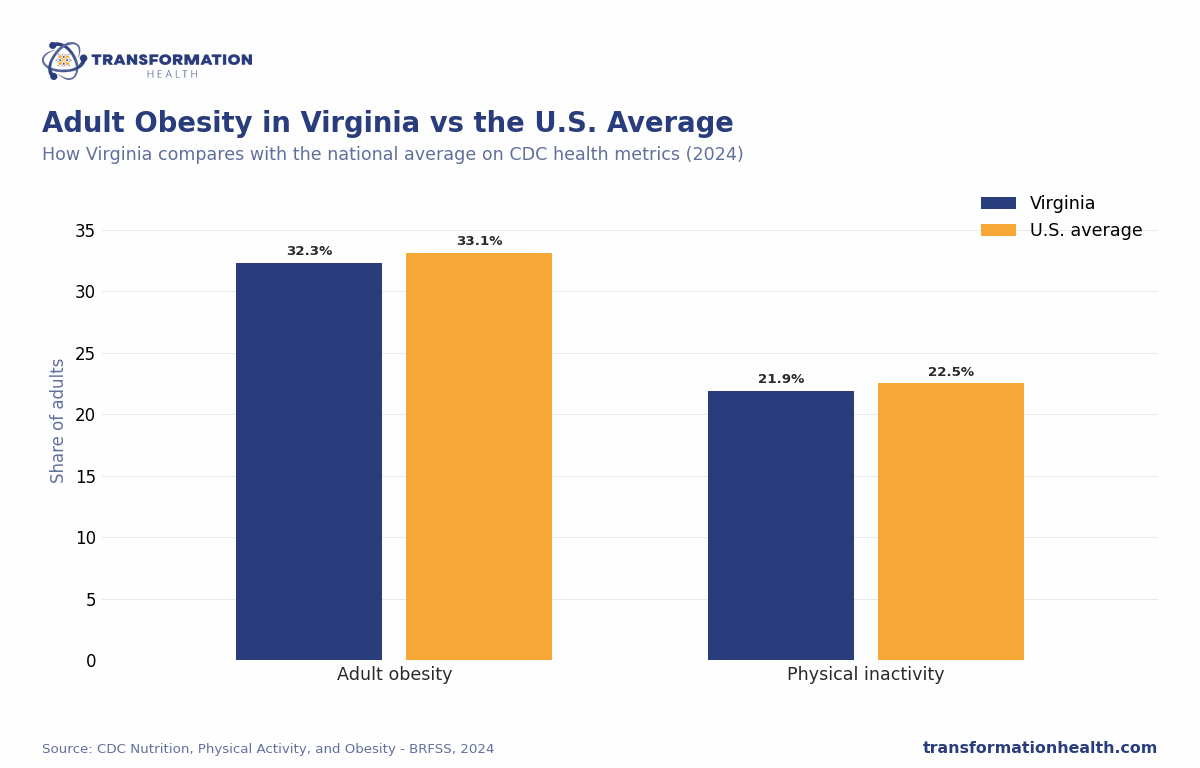
Adult obesity prevalence in Virginia is 32.3%, compared with 33.1% nationally (2024). That places Virginia the 17th lowest of the 51 states and DC.
On physical activity, 21.9% of adults in Virginia report no leisure-time physical activity, versus 22.5% nationally. Activity level is one of several factors a provider weighs alongside weight history and overall health.
| Measure | Virginia | National |
|---|---|---|
| Adult obesity (2024) | 32.3% | 33.1% |
| No leisure-time physical activity (2024) | 21.9% | 22.5% |
Source: CDC Nutrition, Physical Activity, and Obesity, Behavioral Risk Factor Surveillance System, 2024 release. Figures reflect self-reported height and weight. Full sources and methodology are listed at the bottom of this page.
Embed this chart on your site (free)
Copy this code. It credits Transformation Health with a link back to this page.
How Virginia compares to other states
Virginia ranks 35th of 51 states and DC for adult obesity. See how nearby-ranked states compare:
- Idaho obesity and GLP-1 access – 32.7% adult obesity (rank 33)
- Wyoming obesity and GLP-1 access – 32.5% adult obesity (rank 34)
- Minnesota obesity and GLP-1 access – 32.3% adult obesity (rank 36)
- Connecticut obesity and GLP-1 access – 32.0% adult obesity (rank 37)
Or compare every state in one table.
Obesity and GLP-1 access by city in Virginia
Statewide averages hide real differences between Virginia cities. The CDC’s PLACES project publishes model-based city-level estimates, and we break down the data, plus what to compare when choosing a provider, for the largest Virginia cities:
| City | Adult obesity (2023 estimate) | Adult population |
|---|---|---|
| Suffolk | 42.4% | 72,009 |
| Roanoke | 41.9% | 78,948 |
| Newport News | 40.7% | 144,719 |
| Portsmouth | 40.3% | 76,164 |
| Chesapeake | 40.1% | 189,288 |
| Hampton | 40.1% | 109,170 |
| Norfolk | 39.9% | 192,486 |
| Lynchburg | 37.1% | 64,409 |
| Richmond | 36.7% | 187,946 |
| Virginia Beach | 36.5% | 358,086 |
| Dale City | 36.0% | 52,686 |
| Harrisonburg | 33.4% | 42,444 |
| Alexandria | 31.7% | 130,034 |
| Arlington | 24.9% | 196,563 |
| Reston | 24.5% | 51,477 |
| Centreville | 23.4% | 56,536 |
| McLean | 21.1% | 37,525 |
City figures are CDC PLACES model-based estimates, sorted highest first. Each city page shows confidence intervals and full methodology.
Does Virginia Medicaid cover GLP-1 medications for weight loss?
As of October 2026, Virginia Medicaid covers weight-management GLP-1 medications only under narrow conditions. Virginia Medicaid covers semaglutide, tirzepatide, liraglutide, and orforglipron for weight management with service authorization (form effective July 1, 2026), but only at BMI over 40, or over 37 with dyslipidemia, hypertension, or type 2 diabetes. Members must also have failed a non-GLP-1 weight-loss drug, and the provider must attest that the obesity is disabling and life threatening. Approvals last 6 months, and renewal requires at least 5% further weight loss. Coverage rules change frequently, vary by plan, and almost always require prior authorization when weight-management GLP-1s are covered at all. Confirm your current benefits directly with Virginia Medicaid or your plan administrator before making any decisions.
Nationally, obesity-drug coverage in Medicaid remains limited. As of October 2026, our review of the 51 Medicaid programs (50 states and DC) found 8 that cover at least one GLP-1 medication for weight management, usually with prior authorization, 3 that cover them only under narrow conditions, and 8 that ended that coverage in 2025 or 2026. Coverage for type 2 diabetes is more common and is separate from weight-management coverage.
GLP-1 telehealth options in Virginia
If you do not have coverage, do not meet your plan’s criteria, or would rather not go through prior authorization, you will most likely pay cash. In Virginia that usually means one of two routes:
- In-person care. A primary care provider, an obesity medicine specialist, or a weight management clinic in Virginia. You get face-to-face visits and local lab work, and the prescription is filled at a retail or compounding pharmacy.
- Telehealth. An online program whose providers are licensed in Virginia. Visits happen by questionnaire, messaging, or video, and medication is usually shipped to your address.
Neither route is right for everyone. Telehealth can be more convenient, while in-person care can make it easier to manage other health conditions alongside a GLP-1 medication. You do not need a diabetes diagnosis to be evaluated for weight management, and with either route a licensed provider decides whether a prescription is appropriate. The checklist further down this page covers what to compare. For background, see the GLP-1 weight loss guide or whether GLP-1 medications are prescribed if you are not diabetic.
Compounded semaglutide and tirzepatide in Virginia
Some telehealth programs and clinics that serve Virginia residents prescribe compounded semaglutide or compounded tirzepatide, usually at a lower advertised price than brand-name products. Compounded medications are prepared by state-licensed compounding pharmacies and require a prescription from a licensed provider. If a program offers one, ask which pharmacy prepares it and confirm that the pharmacy is licensed to dispense in Virginia.
Compounded medications are not FDA-approved and may differ from brand-name products in formulation, purity, and potency, so a provider should review whether one is appropriate for you before anything is prescribed. These guides cover the specifics:
- How to get compounded semaglutide online
- How to get compounded tirzepatide online
- Compounded GLP-1 without insurance, including how cash-pay pricing works
- What compounded semaglutide costs
Who qualifies for GLP-1 weight management in Virginia
You do not need a diabetes diagnosis to be considered for GLP-1 weight management. A licensed provider generally evaluates candidates with a body mass index (BMI) of 30 or higher, or 27 or higher when paired with a weight-related health condition such as high blood pressure, elevated cholesterol, or prediabetes. The provider reviews your full health history, current medications, and goals before deciding whether treatment is appropriate, so the decision is always individual and never automatic.
On age, each program sets its own limits, and most telehealth weight-management programs serve adults 18 and older. Virginia rules on consent to medical care can also affect the minimum age, so confirm the requirement with any program you are considering. A licensed provider makes the final prescribing decision.
A large share of people seeking GLP-1 weight management in Virginia are women between roughly 35 and 50 who are navigating weight changes tied to perimenopause, when shifting hormones can make weight harder to manage even when nothing else has changed. If that describes you, the appetite and metabolic effects of GLP-1 medications are one option worth discussing with a provider. You can read more about whether GLP-1 medications are appropriate if you are not diabetic and how GLP-1 medications work.
What to check before you choose a GLP-1 provider in Virginia
Out-of-pocket cost is the question most people ask after they learn their plan does not cover weight-management GLP-1s. Advertised prices are hard to compare because programs include different things, so check each option on the same points:
- Licensing in Virginia. The prescriber must hold a license that covers Virginia. You can confirm a license on the Virginia licensing board’s website.
- The pharmacy. Which pharmacy fills the prescription, whether it is a retail or compounding pharmacy, and whether it is licensed to ship to Virginia.
- The medication and form. Brand-name or compounded, semaglutide or tirzepatide, injection or tablet.
- Total cost, including dose increases. Many programs charge more as the dose goes up, so ask what you would pay at each dose, not only in the first month.
- What the price includes. Provider visits and follow-ups, lab work, shipping, and any program fee. Some programs bundle these; others bill them separately.
- How the first visit works. An online questionnaire, messaging, or a live video visit. State telehealth rules and each program’s own policy both affect this.
- Cancellation and refund terms. How to pause or stop, and whether you are charged if a provider decides a prescription is not appropriate.
For more on reading GLP-1 prices, see what GLP-1 treatment costs and how GLP-1 medications compare.
How to Get GLP-1 in Virginia
For someone in Virginia, the steps usually look like this:
- Check your coverage. If you have Virginia Medicaid or private insurance, find out whether it covers GLP-1 medications for weight management and what prior authorization requires.
- Choose a route: an in-person provider in Virginia, or a telehealth program whose providers are licensed in Virginia.
- Compare two or three options on licensing, pharmacy, total cost, and what the price includes, using the checklist above.
- At the program or practice you choose, a licensed provider reviews your health history, current medications, and goals and decides whether a GLP-1 medication is appropriate. Not everyone receives a prescription.
- If a prescription is written, a pharmacy fills it. Telehealth programs usually ship the medication to your address.
You can compare obesity and Medicaid data for other states on the GLP-1 by state page, or read how GLP-1 medications work.
We're relaunching soon
We're relaunching as an independent GLP-1 guide. Leave your email and we'll let you know when your free custom report is ready.
Get StartedData sources and methodology
- Adult obesity and physical inactivity: CDC Nutrition, Physical Activity, and Obesity, Behavioral Risk Factor Surveillance System. Virginia figures are from the 2024 data release; the national comparison is 33.1% (2024). Obesity prevalence is the percentage of adults with a body mass index of 30 or higher, based on self-reported height and weight, so figures may differ from measured surveys such as NHANES. Physical inactivity is the share of adults reporting no leisure-time physical activity (2024).
- Medicaid coverage: Transformation Health review of each state’s Medicaid preferred drug list, prior-authorization criteria, and provider notices, as of October 2026. Virginia-specific status verified against the Virginia Medicaid preferred drug list and prior-authorization criteria, the state’s primary source. State Medicaid coverage of GLP-1 medications for weight loss changes frequently and is summarized here for general information only. Always confirm current benefits and prior-authorization rules directly with Virginia Medicaid or your plan.
- Data current as of: 2024 CDC release. Page last updated: October 17, 2026.
Important: Compounded medications are not FDA-approved products. They are prepared by US-based, state-licensed compounding pharmacies and have not been independently evaluated by the FDA for safety, efficacy, or quality. Medicaid coverage information is general, changes frequently, and should be confirmed with your state program. A licensed provider decides whether a prescription is appropriate. Results vary by individual. Transformation Health is an independent guide. It does not provide medical care, prescribe, or sell medication.